Yes, underwater drones for search missions are already used by police, fire and rescue teams to search lakes, rivers, harbors and the sea. Fitted with a camera and sonar, they can locate vehicles, objects, and missing persons quickly, often before a diver enters the water. They support divers. They do not replace them.
At Frogmen Technologies in the UAE, we distribute underwater drones and underwater positioning and scanning equipment, so this is a question we are glad to answer clearly. Below you will see how these drones work on a search mission, real examples from emergency teams, what they do well, where they fall short, and what to consider if you operate in the UAE.
How Underwater Drones Are Used in Search Missions
A search drone is a small, tethered, battery-powered vehicle. An operator on shore or on a boat flies it with a controller and watches a live video feed. On most search missions, the drone does four jobs:
- Scouting the area first. The team sends the drone in before a diver. It shows the bottom, the depth, and the hazards, so the dive plan is based on what is actually down there.
- Locating the target. Cameras work well in clear water. In murky water, sonar takes over and shows shapes and objects the camera cannot see.
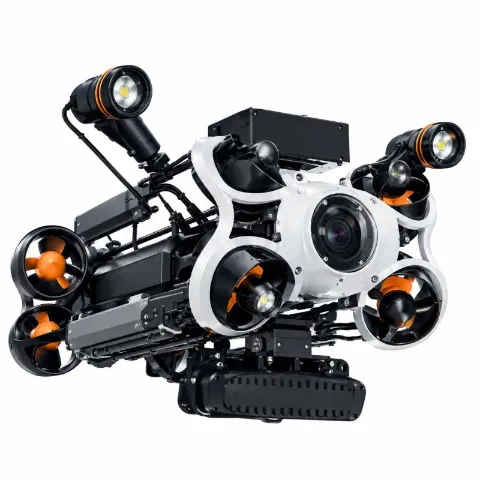
- Guiding the diver. Some teams attach the drone to a submerged object using a gripper arm, then let the diver follow the tether straight to it instead of running a search pattern. Our range of underwater drones with a grabber arm is built for this kind of task.
- Documenting the scene. Video and sonar images give investigators a record of what was found and where.
Why Sonar Matters So Much
A camera alone is often not enough. In dark, silty or stirred-up water, the picture can fall to a few centimetres of visibility. Sonar works like radar underwater. It sends out sound and builds an image from the echoes, so it can reveal a vehicle or object well beyond camera range.
According to a Hydro International report on sonar in missing-person searches, scanning sonar can sweep a circle roughly 250 feet across, while side-scan sonar covers large areas quickly. A drone carrying scanning sonar can then move in and inspect a target that side-scan sonar flagged, so no one has to dive in first.
Real Examples From Emergency Teams
These cases show what drones can do in practice.
- Locating a sunken car in minutes (training exercise). In a fire brigade exercise described by UW Camerastore, a car had sunk to about 6 meters in water with only a few centimeters of visibility. A drone with multibeam sonar found it within minutes, then attached to it with a gripper so the diver could follow the tether. This was a training scenario in calm water, not a live rescue.
- A vehicle about 100 feet down. According to Fox 13 Seattle, the Pierce County Sheriff’s Office used an ROV to find a car that had sunk about 100 feet and to confirm a man was inside within 15 minutes. Divers can only spend around 10 minutes at that depth, so the drone reached a place they could not work safely. The agency says the drone takes about five minutes to deploy.
- Searching at depth in Norway. Blueye Robotics reports that the Norwegian Coast Guard has used its ROVs, including to find a fisherman at around 100 meters. This is the manufacturer’s own account, so treat it as a case study rather than independent data.
Notice a pattern in these examples. In most documented cases, the drone locates the target, and divers or lifting equipment handle the recovery. Drones are a very fast way to find things. They are not yet a way to pull a person out of the water.
The Main Benefits of Using an Underwater Drone
- Speed: The drone can be in the water within minutes and covers ground without the time limits a diver has.
- Diver safety: Divers avoid blind searches in murky, fast, or cluttered water, where entanglement and other hazards are real. Deep Trekker, an ROV maker, notes that police divers are generally limited to about 30 meters (100 feet) and that air use can rise four to five times in a 1.5-knot current.
- Depth and conditions: Drones can work where it is too deep, too cold, or too fast for a diver.
- Live view for the whole team: People on shore can watch the feed and coordinate the search in real time instead of waiting for a diver to surface and report.
- Evidence and records: Recorded video and sonar images help preserve a scene that divers might disturb.
- Training and repeat use: A trained team can run repeated searches with a single drone and spend less time on the scene.
What Underwater Drones Cannot Do
Being honest about the limits builds trust with the teams that rely on this technology.
- They do not replace divers for recovery. Retrieving a vehicle or a victim still needs divers or lifting equipment. A gripper arm can help, but its use should be planned carefully.
- Strong current is a problem. UW Camerastore suggests subtracting about one knot from a drone’s top speed to estimate the current it can hold position in. Many drones top out around 3 knots, so fast water can push them off course. Add-ons such as a DVL or USBL positioning system help with holding the station.
- They need a trained pilot. A drone must be flown actively, and judging position and distance underwater without reference points takes practice.
Some of the figures above come from manufacturers and retailers, so they are best read as a guide to what is possible, not as guaranteed results.
Underwater Drones for Search Missions in the UAE
The UAE has a long coastline along the Arabian Gulf and the Gulf of Oman, as well as busy ports, marinas, creeks, canals, reservoirs, and dams. Any of these can become the site of a search or recovery, and conditions differ a lot from one place to the next. Official search and rescue in the UAE is carried out by the relevant authorities. Frogmen Technologies supplies the equipment and technical support that teams and organizations use alongside them.
Here is what we would ask any UAE team to think about before choosing a drone:
- Visibility. Wind, boat traffic, and sandy or silty bottoms can cut visibility sharply in coastal and harbor water. That makes sonar especially valuable.
- Current and tides. Channel mouths and creeks can move fast. Check thrust and station-keeping support before you buy.
- Heat. Keep drones, controllers, and batteries shaded and cool between dives, and follow the manufacturer’s temperature guidance.
- Communication and navigation. Search teams work better when positions and signals are reliable. Browse our communication and navigation systems.
- Safety equipment. For wider search and rescue needs, such as locating people in distress, see our Mobsos distress beacon.
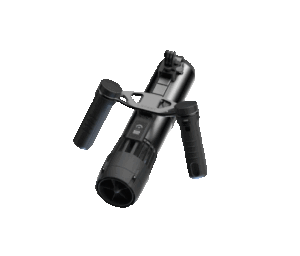
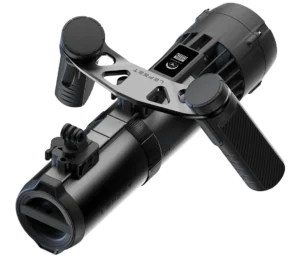
- Portable, quick-deploy drones. Our Chasing underwater drones are compact models worth reviewing for fast deployment, so check each model’s specifications against your own search conditions.
If you need inspection work done rather than equipment, such as dams, hulls, tanks, or pipelines, our ROV inspection services may be what you are looking for.
What to Look For in a Search Mission Drone
If your team is thinking about adding an underwater drone, check these points before buying.
- Sonar compatibility. A drone that accepts imaging or multibeam sonar is far more useful in low visibility.
- Thruster power. Stronger thrusters help hold position in the current.
- A gripper arm. If you want to attach to objects or retrieve small items, look at underwater drones with a grabber arm.
- Tether length and depth rating. Match both to the deepest water you are likely to search.
- Battery life and quick deployment. Search work is time-sensitive, so a fast setup and enough runtime matter.
- Accessories and spares. Check what you can add later in our underwater accessories shop.
- Training and support. The best drone is only as good as the team operating it.
Frequently Asked Questions
Can underwater drones find missing persons?
They can help locate people, vehicles, and objects underwater, especially when fitted with sonar. Emergency teams have used them to find victims quickly in lakes and open water. Divers are still normally needed to recover a person.
Can an underwater drone replace a dive team?
No. Drones reduce the number and length of dives and make them safer, but divers are still needed for recovery and for situations that need hands-on work.
How deep can an underwater drone search?
It depends on the model. Compact drones commonly work at depths of tens of metres, and larger professional units can go deeper. Always check the depth rating and tether length of the specific drone.
Do underwater drones work in murky water?
The camera has limited use in murky water, but sonar can still build an image. This is why sonar is considered close to essential for search work.
Where can I buy underwater drones in the UAE?
You can browse our full range in the Frogmen Technologies shop or contact our team for advice on matching a drone and sonar to your conditions.
Final Thoughts
So, can underwater drones be used for search missions? Yes, and they already are. They find targets faster, keep divers out of dangerous water, and give the surface team a live view of the search. They work best as part of a team alongside trained divers and good planning, with sonar doing the heavy lifting in poor visibility.
If you are looking at underwater drones, sonar, or grabber arms for your team in the UAE, contact us and we will help you choose the right setup.